
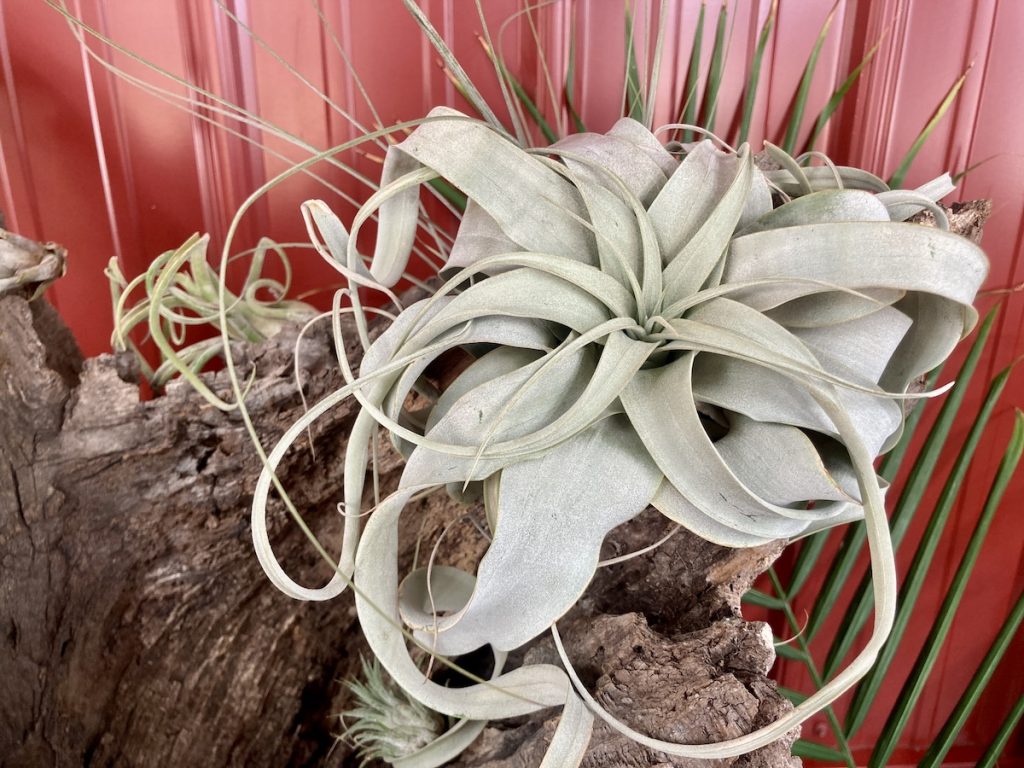
Air plants are bromeliads in the genus Tillandsia. They are epiphytes, meaning they grow on other plants or objects rather than in soil. Their roots serve only to anchor them in place. Air plants absorb water and nutrients through their leaves, which are covered in tiny scales called trichomes.
Air plants are native to subtropical and tropical regions, and different species grow in habitats ranging from deserts to rainforests. In nature, they grow nestled in trees, vines, rocks, and moss, and even on man-made structures, wherever they get indirect light and moisture from dew, fog, mist, or rain.
Light
Air plants do best with 4–6 hours of bright, indirect light each day. Direct sunlight can overheat the leaves and dry the plant out too quickly.
Indoors, place them 1–3 feet from an east-, south-, or north-facing window. During the hottest part of the day, close a shade or sheer curtain to protect them.
If natural light is limited, a full-spectrum grow light can be used for 8–12 hours per day.
Signs of light problems:
- Too much light: leaves look crispy, brown, or bleached.
- Too little light: faded color and weak, slow growth.
Water
Mist heavily 2–3 times a week, making sure to wet the entire plant, including the base.
In very dry conditions (for example, with wood stove heat in winter), soak the plant in water instead: about 10 minutes for small plants and 20 minutes for larger ones.
After soaking, turn the plant upside down and gently shake out the excess water. Let it dry upside down on a paper towel for 1–4 hours before returning it to its display. Water left sitting at the base of the plant will cause rot.
Do not plant air plants in soil. They are not adapted to grow in soil, and it will cause them to rot quickly.
Fertilizer
Air plants need very little feeding.
Once a month during the growing season, use a water-soluble bromeliad or orchid fertilizer at ¼ strength. You can soak the plant in the mixture or spray it over the entire plant. Avoid fertilizers containing urea, boron, zinc, or copper, as these can burn the leaves.
Plant probiotics (beneficial microbes) may also help strengthen air plants and support healthy growth and flowering. These microbes colonize the plant’s surface, where they can help protect against harmful pathogens and break down organic debris into nutrients the plant can use.
How to “Plant” an Air Plant
You don’t actually plant an air plant; you place or mount it. Air plants can be attached to almost anything, as long as you can still water and feed them. Common methods include hot-gluing them to driftwood or rocks, or securing them to objects with wire. Another popular option is nestling them in Spanish moss or sphagnum moss, which helps hold moisture around the plant.
Pests
Like other plants, air plants can have problems with disease and insects. The most common pests are scale, mealybugs, and spider mites.
- Scale and mealybugs are usually easy to spot as white, cottony clusters, especially in the tight spaces between leaves.
- Spider mites appear as tiny light- or dark-colored specks on the plant.
Treat infestations with insecticidal soap or neem oil as needed.
Ready to add an air plant to your home? Stop by Grass Roots in Marshfield, MO to browse our selection. With so many shapes, sizes, and colors to choose from, there’s an air plant for every space and style, whether you’re a first-time plant owner or a seasoned collector.
Our team is happy to help you choose the right plant, find a creative way to display it, and answer any care questions along the way. Come see us and bring home a little piece of the tropics!